
Have you ever carefully written an article or long-form post only for somebody to run it through an AI detector and say, “This was written by AI”?
Frustrating, right?
You put real time and energy into writing something thoughtful, only for somebody to confidently say something ridiculous like, “Only AI uses em dashes,” and suddenly your work gets dismissed like it couldn’t possibly be your own.
Honestly, it’s kind of insulting.
It’s kind of like some script on a webpage somewhere decided your intelligence is statistically suspicious, and then somebody who doesn’t know any better, or can’t be bothered to verify anything themselves, decides you’re a fraud.
Here’s the thing though – that’s actually a compliment, and you’re in very good company.
Some of the greatest fully human-written works in history have been flagged as AI-generated.
Parts of the Bible have triggered AI detectors. Shakespeare has triggered AI detectors. So have books and works like:
- Pride and Prejudice
- Jane Eyre
- Do Androids Dream of Electric Sheep?
- The Federalist Papers
- Moby-Dick
- 1984
- The Great Gatsby
- The Art of War
- The Communist Manifesto
- A Tale of Two Cities
…and many more.
So why does that happen? How do AI detectors actually work, why do they falsely flag human writing, and more importantly, how do you avoid triggering them without intentionally making your writing worse?
AI Detectors Are Not Detecting Intelligence
One of the biggest misconceptions about AI detectors is the idea that they somehow know whether a human being physically wrote something.
They don’t.
AI detectors are not magical truth machines. They’re not mind readers, lie detectors, or plagiarism checkers either. At the end of the day, they’re pattern analysis systems looking for statistical similarities commonly associated with machine-generated text.
In other words, they’re not asking:
“Did a human write this?”
They’re asking:
“Does this statistically resemble patterns often produced by large language models?”
Those are two completely different questions, and once you understand that distinction, false positives suddenly make a whole lot more sense.
Here’s the ironic part: a lot of highly polished human writing naturally resembles the same patterns AI models were trained on in the first place because AI learned from human writing.
So when detectors flag Shakespeare, the Bible, political essays, philosophical works, classic literature, or formal nonfiction, they’re often not detecting “AI.” They’re detecting consistency, clarity, coherent structure, polished syntax, predictable progression, and lower randomness.
Ironically, those are often signs of strong writing.
Why AI Writing Often Feels Weird
Now here’s where things get interesting.
Most AI-generated writing doesn’t feel off because it’s unintelligent. It feels off because it’s flattened.
AI naturally trends toward clarity, compression, balance, structural consistency, grammatical correctness, and predictable pacing. That sounds good on paper, but the problem is that human communication doesn’t actually work like that.
People pivot mid-thought. We repeat ourselves for emphasis, soften ideas, interrupt ourselves, use analogies, change pacing naturally, slow down on important ideas, and speed through familiar ones.
Human communication has rhythm to it, and AI writing often doesn’t.
That’s why so much AI-generated content feels sterile even when the information itself is accurate. It reads like assembled information instead of active thought, and ironically, that’s exactly the kind of thing detectors often flag.
The Real Problem With Most “AI Humanizers”
A lot of people respond to this the wrong way.
They intentionally damage their writing to make it “look human.”
So they:
- inject mistakes
- use awkward wording
- swap words with random synonyms
- force weird sentence structures
- intentionally lower writing quality
That’s not human writing.
That’s damaged writing.
And honestly, some of the advice floating around online right now is borderline absurd. Apparently proper grammar is suspicious now. Using em dashes means you’re secretly a robot. Writing clearly is somehow “too AI.”
Meanwhile, centuries of human writers are collectively rolling in their graves.
The goal should never be to sound less intelligent.
The goal is to sound more human.
Those are not the same thing.
Human Writing Feels Like Someone Is Actually There
This is the part most people miss.
Human writing isn’t defined by imperfections.
It’s defined by presence.
Good writing feels like somebody is there explaining something to you, thinking out loud, and walking you through an idea instead of dropping polished information on the page and calling it finished.
That’s why conversational bridge phrases matter so much.
Phrases like:
- “Here’s the thing…”
- “It’s kind of like…”
- “And honestly…”
- “What’s interesting is…”
- “The reason for that is…”
…aren’t just filler.
They’re conversational mechanisms that guide attention, create pacing, soften transitions, and simulate interaction.
In other words, they make writing feel spoken instead of manufactured.
That matters because people don’t emotionally engage with information the same way they engage with communication. The moment writing starts feeling like a real person is behind the words, the reader stops feeling like they’re consuming content and starts feeling like somebody is talking directly to them.
Ironically, that’s often when AI detectors become less confident too because the writing stops looking statistically flattened and starts looking behaviorally human.
So What Do I Mean By “Simulate Presence”?
Here’s what I mean by simulate presence: write like you speak.
There’s a HUGE difference between being grammatically correct and “being human.”
Have you ever noticed that how we write and how we speak are completely different? Imagine for a moment that you tried speaking to another human being the same way you would write a formal article or a term paper.
It would sound really weird, right?
Nobody naturally talks like that.
We don’t generally speak the way we write, and we don’t generally write the way we speak. That’s part of the problem.
What you want to do is make your writing match human speech patterns. You can still be grammatically correct, precise, intelligent, and structured, but the goal is to change the cadence, pacing, and structure so it sounds like a real human being communicating naturally.
And honestly, this works extremely well because human beings are wired for conversation.
Now, in more formal settings where literary styling is stricter, this approach can become a little more difficult, but it can still work.
The added bonus is that once your writing starts sounding more conversational, it usually becomes more compelling and engaging too, even if you aren’t intentionally using persuasion language or neuro-linguistic programming techniques.
Why?
Because readers stop feeling like they’re consuming information and start feeling like somebody is talking directly to them.
That’s the difference.
Here are 5 rules I personally follow, both when I’m drafting articles myself and when I’m having AI help draft content for me.
1. Understand the goal is to make your content read like a knowledgeable human shaped the piece for real readers.
Use contractions by default where they sound natural:
- it’s
- don’t
- you’re
- that’s
- can’t
- won’t
- they’re
2. Use expanded forms like “do not,” “will not,” or “cannot” only when the sentence needs extra weight, such as a warning, formal statement, legal/regulatory point, or firm editorial constraint.
3. Prefer natural sentence flow over stiff, chopped-up sentence stacking.
If two ideas clearly belong together, connect them with ordinary conjunctions like “and,” “but,” “so,” or “because.”
Do not break every idea into a separate short sentence just to sound clear.
Short sentences are useful, but use them intentionally for:
- emphasis
- contrast
- warnings
- sharp transitions
- closing lines
4. Avoid robotic rhythm where every paragraph sounds like:
“This matters. It affects businesses. Operators should pay attention.”
Prefer a more natural version:
“This matters because it affects how operators plan, spend, and stay compliant.”
5. Prefer ASCII characters and punctuation over common AI or machine-generated punctuation.
A lot of modern AI writing has small stylistic tells that most people don’t consciously notice, but they’ve started subconsciously associating them with machine-generated content.
That doesn’t mean punctuation is bad. It just means AI systems often lean heavily into things like:
- excessive em dashes
- overly polished punctuation styling
- perfectly balanced formatting
- typographically “perfect” structure
Human writing tends to be a little more uneven and natural.
Sometimes a normal comma works better than a perfectly placed em dash. Sometimes standard quotation marks feel more natural than typographically perfect punctuation.
Ironically, tiny details like that can subtly affect how human your writing feels, even when readers don’t consciously realize why.
At the end of the day, the goal isn’t to make your writing worse.
The goal is to make it feel like a real person is there behind the words.
A Real Example From My Own Workflow
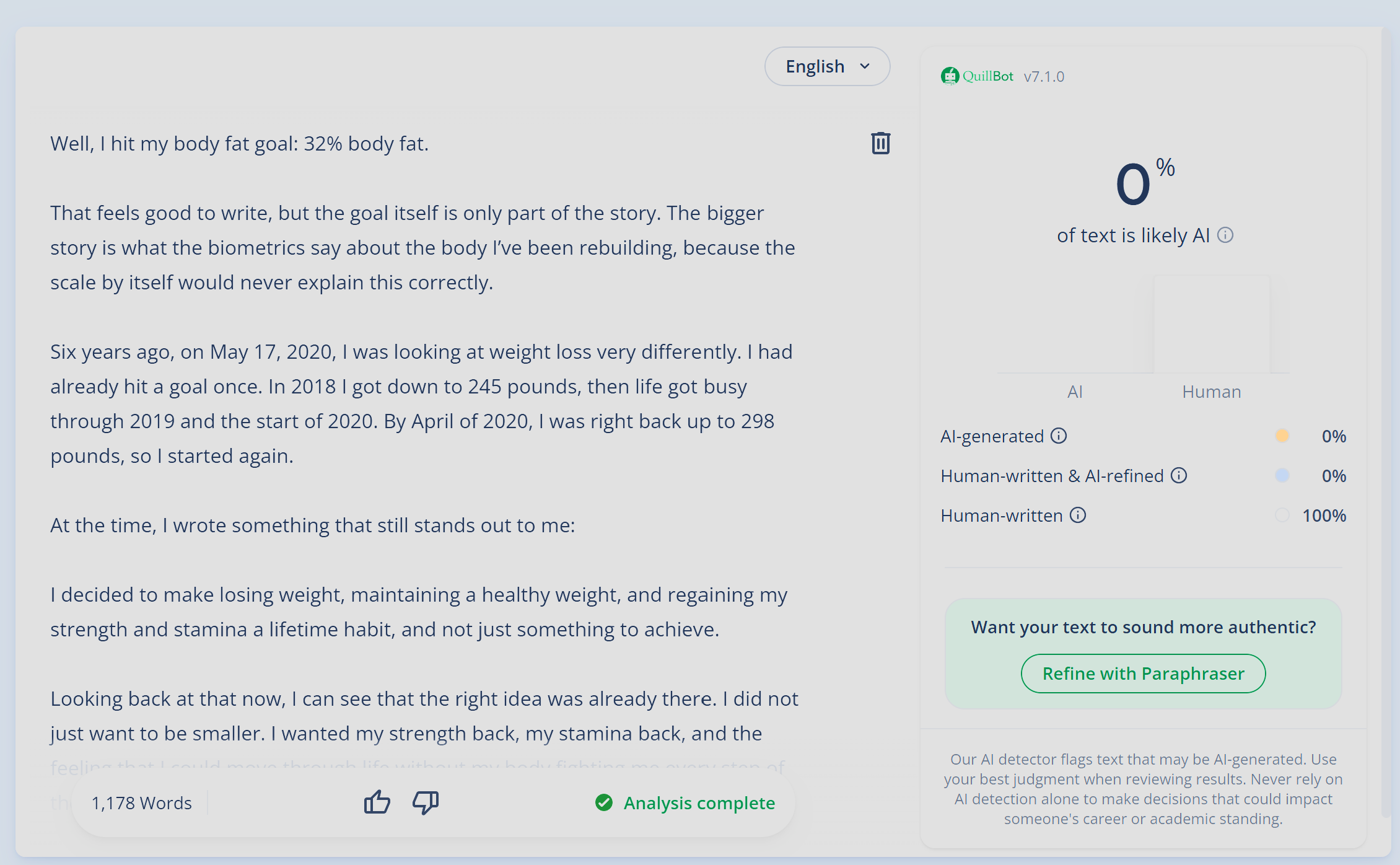
Recently, I created a video showing off an AI tool I built, TechDex WP Toolkit for AI, and I had it generate four articles for me using these same rules, along with my other writing preferences.
That part matters because the point was not to trick a detector by making the writing worse. The point was to shape the output so it sounded like a real person with actual context, rhythm, and intent had worked through the piece.
After that, I ran one of the generated articles through an AI detector.
Here was the result:
Now, does that prove the detector is perfect?
No. That’s actually the whole point.
It proves that these systems are responding to patterns, not truth. When writing has more natural cadence, better conversational flow, clearer presence, and fewer machine-like structural tells, the detector becomes less confident that it is looking at AI-generated text.
And that brings us right back to the real lesson: the goal is not to damage your writing so it looks more human. The goal is to make sure the writing actually feels like somebody is there.
Frequently Asked Questions About AI Detectors and Human Writing
Why do AI detectors falsely flag human writing?
Because AI detectors don’t actually know whether a human being wrote something. They analyze statistical patterns commonly associated with machine-generated text, and strong human writing can naturally share some of those same traits.
That is especially true when the writing is clear, structured, grammatically consistent, and easy to predict. Those are not proof of AI. They are just patterns a detector may associate with AI-generated output.
How accurate are AI detectors really?
Not nearly as accurate as many people assume.
AI detectors can be useful as weak signals, but they are not reliable proof of authorship. They can produce false positives, miss AI-written text, and misread human writing that happens to fit the statistical profile they are looking for.
That is why an AI detector score should never be treated like a final verdict by itself.
Why does polished or formal writing trigger AI detectors?
Polished writing often has the same surface traits that AI systems naturally produce:
- clear structure
- predictable syntax
- balanced pacing
- consistent grammar
- logical progression
Ironically, those can be signs of good writing. But because AI systems are trained to produce polished, coherent text, detectors may treat those qualities as suspicious when they appear together too consistently.
Do em dashes make writing look AI-generated?
Not by themselves.
Human writers have used em dashes for centuries. The issue is that many AI systems tend to overuse certain punctuation patterns, including em dashes, especially when they are producing polished explanatory prose.
So the punctuation mark is not the problem. The pattern is.
Can good writing look “too AI”?
Yes, and that is part of the problem.
Clear, polished, grammatically correct writing can sometimes get treated as suspicious because people have started associating smooth writing with automation. That does not mean the writing is AI-generated. It means the detector, or the person reading the detector score, may be confusing quality with machine-like predictability.
How do you make AI-assisted writing sound more human?
You stop treating writing like information delivery and start treating it like communication.
Human writing has rhythm, pacing, conversational transitions, thought progression, emotional continuity, and natural variation. It does not just present information. It feels like a person is actively guiding the reader through an idea.
The goal is not to add random mistakes. The goal is to make the writing feel shaped by a real mind.
What’s the best way to beat AI detectors without making your writing worse?
Write the way real human beings communicate.
The strongest humanization techniques are not tricks or hacks. They are conversational flow, rhetorical pacing, cadence variation, natural transitions, structural rhythm, and presence.
In other words: write like you speak, but with enough structure that the reader can follow you.
TechDex Presents…
Flashback to the ’90s
Get 2026 services at 1990s prices.
For a limited time, I’m rolling prices back on six focused small-business services. Choose one service for $800, or choose two for $1,200. Nothing is purchased here—I’ll review your request and confirm the scope with you first.
Based on this article, these are the best places to start:
The campaign form lets you choose one or two services and request a follow-up. It isn’t a checkout, and you won’t be billed when you submit it.